
presentations

articles from insights
Featured

In Canada v. Cameco Corporation, the Canada Revenue Agency (“C.R.A.”) challenged Cameco's transfer pricing arrangements with its Swiss subsidiary during the early years of the twenty-first century. In 2018, the Tax Court of Canada ruled in favor of Cameco, finding that the transactions were not shams and were conducted on arm's length terms. In 2020, the Federal Court of Appeal unanimously upheld the decision, rejecting the C.R.A.'s arguments that profits were inappropriately shifted. The recent Canadian federal budget introduced new Canadian transfer pricing legislation containing the most consequential change since 1997. In his article, Michael Peggs explains that the amendment has something for everyone: a response to the decision in Cameco, alignment with O.E.C.D. guidance, and harmonization with treaty partners.

In an article published in Insights in 2022, Michael Peggs commented that the Tax Court knew where it wanted to end up and simply looked for a method that was consistent with its destination. He predicted that the approach of the Tax Court was not likely to be upheld on appeal. In early September, the Tax Court’s decision was vacated and remanded for further proceedings. In the “boxing matches” taking place between (1) Medtronic and the I.R.S. and (2) the Tax Court and the Court of Appeals, it seems the boxers are in the fourth round of a ten-round bout. Stay tuned.

As promised before the end of 2024, the I.R.S. has outlined its approach to the codification of Amount B, a component of the O.E.C.D. Pillar One approach to controlled distribution transactions of tangible property. Notice 2025-04 allows taxpayers to elect to use the streamlined, simplified approach (“S.S.A.”) for corporate tax years beginning on or after January 1, 2025. If a valid election is made, the I.R.S. will consider the S.S.A. to be the best method under the Treas. Reg. §1.482-1(c). While touted as a method that brings simplicity to transfer pricing, in practice simplicity is achieved at the price of certain important concepts fundamental to the arm’s length standard codified in tax law. Michael Peggs does yeoman’s work in taking the reader through the steps to be followed, the conditions to be applied, and the variable values that pop out of the S.S.A. machine. To readers who have given transfer pricing advice over the years, Amount B may seems to be based on concepts of the command economy of bygone days rather than market transactions.

Except for the U.S., transfer pricing law frequently includes a provision that references the O.E.C.D. T.P. Guidelines as the guidance that must be used to interpret other provisions of relevant law. Nonetheless, national tax administrations publish their own interpretive guides to the O.E.C.D. T.P. Guidelines, thereby adding to a body of administrative guidance that can vary from country to country. The European Commission has recently proposed a Council Directive on transfer pricing released as part of the Business in Europe: Framework for Income Taxation (“B.E.F.I.T.”). The Directive proposes to codify the arm’s length principle and elements of its interpretation from the O.E.C.D. T.P. Guidelines. This elevates the O.E.C.D. T.P. Guidelines into E.U. law, thereby making them more than an arm’s length principle interpretive standard. It does so with several subtle and not-so-subtle variations. Michael Peggs and Michael Bennett caution that making soft law into hard law impairs the ability of tax administrations to compromise on points of controversy.

Bad blood exists between the I.R.S. and Medtronic Inc. when it comes to transfer pricing matters. Regarding the tax years 2005 and 2006, the I.R.S. challenged a transfer pricing methodology it approved in an M.O.U. settlement with Medtronic involving the same transactions and issues in the context of an earlier year. The I.R.S. lost in an earlier case, appealed to the 8th Circuit Court of Appeals, which sent the matter back to the Tax Court to address several factual issues. In a recent decision, the Tax Court modified its earlier finding by adjusting the comparable uncontrolled transaction (“C.U.T.”) in a subjective way to obtain a result that seemed to be fair in the view of the court. Michael Peggs suggests that the second trial did not produce practical guidance that was any better than the very limited guidance in the original decision.

· A sale of a business often involves an element of goodwill, a term that can have different meanings in different contexts, depending on whether the term relates to (i) purchase price allocations for financial statement purposes or income tax purposes or (ii) attempting to compute the source of income for foreign tax credit purposes. Compounding the definitional inconsistency, the meaning of the term has changed over time. In a 25-year old case, the overseas Mister Donut franchising business was sold to a foreign buyer in an asset-sale transaction. Although only intimated in the case, the taxpayer likely had significant amounts of deferred assets on its balance sheet arising from unused foreign tax credits. Because the seller was a U.S. company, gain from the sale of business generally results in the generation of domestic source income. Under the law in effect at the time, goodwill was sourced where business was carried on. Was that provision the key to access deferred foreign tax credits? The U.S. Tax Court said no. Sometimes, goodwill is not goodwill for foreign tax credit planning purposes. Michael Peggs and Wooyoung Lee look at the court’s reasoning and comment on certain contemporary aspects of the decision in light of provisions in the Tax Cuts and Jobs Act and several I.R.S. pronouncements on goodwill.

In every decade, a phrase or a term pops up that is widely used, although its meaning may vary from person to person. Examples in past decades include “groovy,” “viral,” “neat,” and “heavy.” In his article, Michael Peggs identifies “value creation” as a phrase that has gone “viral” among the O.E.C.D., the G-20, and tax authorities. The “neat” aspect is that, over the centuries, the term has meant different things to different commentators. Nonetheless, it remains the central foundational feature of controlling policy for global policy wonks. It could mean that while everyone appears to be marching in unison, they are really marching in different directions, much to the chagrin of multinational enterprises. “Heavy!”

Two transfer pricing cases, Commissioner of Taxation of the Commonwealth of Australia v Glencore Investment Pty Ltd. in Australia and Cameco Corporation v. Her Majesty The Queen in Canada, address arm’s length transfer pricing methodology for mined minerals during a period of steep increases in spot prices. In each case, the revenue authority challenged the taxpayer’s revision of pricing from the use of fixed prices to adjusted prices that were comparable in methodology to contemporaneous uncontrolled transactions. Each case was decided in favor of the taxpayer. Michael Peggs explains the reasons why the approaches of the tax authorities were rejected. He cautions that the precedential value of the cases may be limited in light of changes made in the 2017 version of the O.E.C.D. Guidelines. One ongoing takeaway from the two cases is that, to settle a transfer pricing dispute, a large multinational company must be prepared to make significant investments in data gathering, executive, time, and cost of litigation.

In Coca-Cola Co. & Subsidiaries v. Commr., the taxpayer learned an important lesson for multinational groups using a residual profit split method to determine intercompany transfer prices. The factual underpinning of a residual profit split is critical to method selection, best method analysis, and selection of a reliable split metric when applying the method. In the case, the taxpayer relied on a favorable resolution of transfer pricing issues in an examination of earlier years and failed to confirm the continued existence of favorable facts. Michael Peggs explains all. Resolution of an examination does not provide the same certainty as an advance pricing agreement.

It seems in the world of transfer pricing litigation, a pattern of mutual expectations has emerged. Companies expect tax authorities to take revenue-maximizing positions and expect courts see the issue more clearly and vacate or substantially vary the assessment of the tax authority. At the same time, tax authorities expect that courts will uphold audit findings of material transfer pricing income adjustments using methods and data overlooked or ignored by companies. In October, the Danish Tax Agency received a decision from the Western High Court concerning an appeal originating from a transfer pricing audit commenced in 2006. Michael Peggs explains the reasons for the 14-year marathon and ponders whether transfer pricing norms in a post-B.E.P.S. world will put an end to this type of examination.

Earlier this year, the I.R.S. updated its Transfer Pricing Documentation Best Practices F.A.Q. list with a response to Q. 4. What are some areas the I.R.S. has identified in transfer pricing documentation reports that could benefit from improvement? It seemed to be a reaction to two events on the global tax stage. First, the I.R.S. regularly encounters too many suboptimal reports that provide unreliable data leading to a prolonged examination. Second, recent activity in the European Union and the O.E.C.D. suggest that U.S. taxpayers face claims of local value-creation by foreign tax authorities, resulting in increased foreign income allocations. Such allocations reduce the U.S. tax base. Michael Peggs discusses do’s and don’ts explained by the I.R.S., and the benefits that are obtained from a robust transfer pricing report, both within budget-related considerations of a global company.

The O.E.C.D. announced on January 31, 2020, that its policy development efforts under Pillar One, related to the taxation of the digital economy, will move forward using the non-consensus “Unified Approach” as a working model. The O.E.C.D.’s deadline for obtaining a consensus outcome is highly ambitious. Michael Peggs provides his views. Despite what people may think about when this effort should have begun, it is crucially important that it has begun at last and in an organized way.

How does a group of experts comment on the indescribable in order to arrive at a consensus? Inconsistently is the answer. As the O.E.C.D. continues its work on the taxation of the digital economy, the O.E.C.D. Centre for Tax Policy and Administration received comments in advance of a public consultation in late November 2019. The public consultation heard input from interested parties on the policy development aspects of a "Unified Approach" to the determination of tax nexus and profit allocation rules relevant to customer-facing corporate participants in the digital economy. From the consultation, a "great divide" appears to exist on the Unified Approach. The policy interests are clearly inconsistent when looking at (i) tech haves v. have-nots and (ii) consumers v. producers. The broadly North-South partition that caused the demise of the E.U. Commission’s significant digital presence and D.S.T. directives continues to be argued in the larger forum of the O.E.C.D. Tech haves and producers appear to share a common view with U.S. tech firms. Michael Peggs explains the divide in quantitative terms and suggests that, with the exception of the U.K., the adage that looks to see "whose ox is being gored" is a useful tool in identifying those jurisdictions that support digital taxes and others that are opposed.

As of November 2019, the arm’s length principle continues to operate among the O.E.C.D. Member States. In a little more than a year, this may be different. The O.E.C.D.’s workplan for urgent policy development will investigate a new nexus standard that departs from the arm’s length principle applied for decades. In his article, Michael Peggs explains the current debate between tax administrations concerning the attribution of profit to digital or non-physical P.E.’s and the three popular approaches that have been proposed. The mood in the O.E.C.D. is that markets matter most under each of the suggested approaches. Brainpower and manufacturing prowess are less important.

The limitation of interest deductibility to 30% of adjusted E.B.I.T.D.A. has focused the attention of U.S. corporations and their lenders on new constraints. How does a borrower demonstrate the capacity to carry and service debt, and how do related parties demonstrate that the rate of interest and other terms attaching to a cross-border loan are arm’s length? Michael Peggs and Stanley C. Ruchelman address these issues, explaining the three methods used to identify the boundary between debt and equity: (i) the qualitative approach of case law (I know it when a I see it, although I can’t agree to a uniform standard of application), (ii) the data-driven approach of comparative analysis (I know it when I can measure the effect, much like gravity), and (iii) the procedural approach for borrowers as set out in the Code §385 regulations which were in effect for a short period of time (I know it when I follow the recipe in the regulatory cookbook).

In July, the O.E.C.D. Centre for Tax Policy and Administration released Public Discussion Draft on B.E.P.S. Actions 8-10: Financial transactions (the “Discussion Draft”) addressing financial transactions (e.g., loans, guarantees, cash pools, captive insurance, and hedging). Michael Peggs and Scott R. Robson review the draft guidance and express disappointment. The Discussion Draft is not a thought leader, as tax authorities have successfully litigated the issues inherent in intercompany loans. Decided cases generally reflect a “not in my back yard” approach to deductions for interest expense. The Discussion Draft makes statements regarding allocation of risks in financial transactions that are inconsistent with arm’s length evidence. It also promotes decisions based on 20-20 hindsight. All these lead to several unanswered questions: What is the ultimate meaning of the term “arm’s length” when used in a cross-border financial transaction? Is it the terms and conditions that exist in actuality among lenders and borrowers, or is it the terms and conditions that should exist in the mindset of the tax authorities?

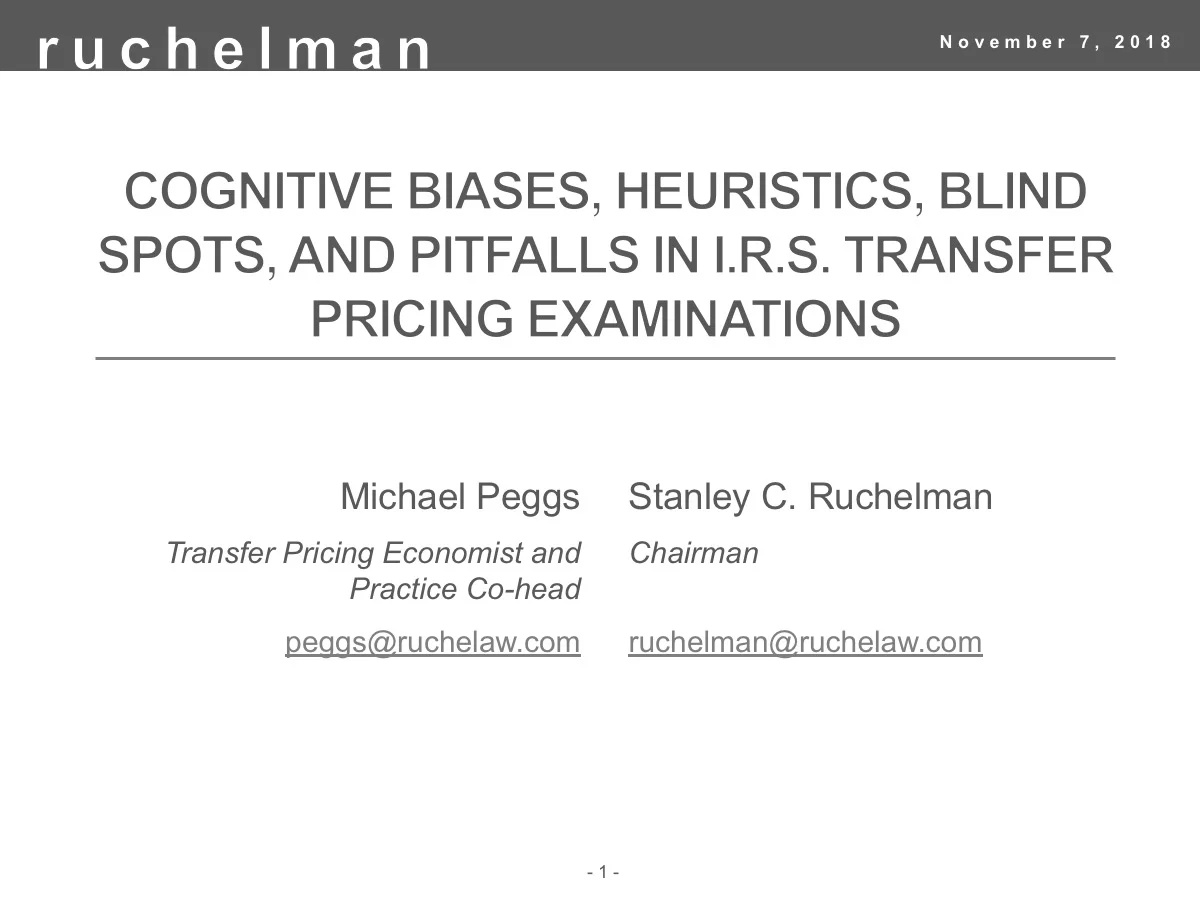
For management of a U.S. subsidiary of a foreign parent, the process by which the I.R.S. conducts an examination of a tax return creates a heightened stress level. It begins with the arrival of an information document request ("I.D.R.") for transfer pricing documentation, which often comes as a surprise to a company. Typically, two or three years have passed since the close of the year under examination and little is recalled about transactions. From there, the expressed positions of I.R.S. examiners and management often are at odds. Drawing on many years of experience in defending intercompany transfer pricing policies, Michael Peggs takes a step back from the fray to examine how opposing, pre-conceived notions on both sides combine with the Semmelweis Reflex to exacerbate what should be a straightforward tax examination.

Experienced tax litigators know that Congress often protects the I.R.S. when an important case is lost. Yes, the taxpayer wins. But Congress codifies the I.R.S. position by an amendment to the law. The T.C.J.A. revised Code §482 legislatively, thereby reversing Tax Court decisions in the Amazon and Veritas cases that dismissed two arguments raised by the I.R.S. in transfer pricing litigation – mandatory use of aggregate basis of valuation (grouping of intangibles for valuation purposes) and the realistic alternative principle (challenging the business judgment for the transaction). Michael Peggs and Sheryl Shah explain this attack on the arm’s length principle of taxation.

The B.E.P.S. Action 14 Report, Making Dispute Resolution Mechanisms More Effective, acknowledged that the actions to counter B.E.P.S. must be complemented with effective dispute resolution mechanisms. Participating countries agreed to have their compliance with the minimum standard reviewed by their peers. The U.S. is among the first few countries that have been reviewed. Neha Rastogi and Michael Peggs summarize the M.A.P. report card issued for the U.S.

A recent U.S. Tax Court decision involving Eaton Corporation affirmed that the I.R.S. cannot arbitrarily circumvent administrative rules that are set down in revenue procedures and relied upon by the I.R.S. and a taxpayer. As a result, the I.R.S. must reasonably exercise its discretion when seeking to terminate an advance pricing agreement with a taxpayer. Michael Peggs looks at the process of obtaining an advanced pricing agreement and comments on the court’s decision.

Last month, Insights reported on the Tax Court decision in Amazon v. Commr., involving the “buy-in” payment made as compensation for the right to use pre-existing I.P. in a related-party cost-sharing arrangement (“C.S.A.”). This month, Michael Peggs comments on the lessons learned from the taxpayer victory in that case regarding (i) the transfer pricing method used, (ii) the assumptions made and analyses used to value the buy-in payment, and (iii) the correct treatment of intangible development costs within the term of the C.S.A.
This month, the authors look briefly at several timely issues, including (i) the filing of appeals briefs in two major cases lost by the I.R.S., Altera and Xilinx, (ii) recent competent authority activity between the U.S. and India, (iii) the future of U.K. automobile assembly plants operated by U.K. subsidiaries of Japanese automakers, and (iv) final State Department rules concerning the revocation of U.S. passports issued to individuals who have a seriously delinquent tax debt. Kenneth Lobo, Michael Peggs, Nina Krauthamer, and Sultan Arab contribute.
One of three releases on July 4, the O.E.C.D.’s Additional Guidance on the Attribution of Profits to Permanent Establishments addresses the imponderable question – how much profit should be attributed to a P.E.? The answer will make tax advisers quite happy: It depends on the facts, and the O.E.C.D. suggests that a coordinated global approach is required to avoid double taxation. Stakeholders are invited to comment. Michael Peggs examines five examples in the additional guidance.
A New Way to Do the Splits: B.E.P.S. Guidance Falls Short of Enabling Global Formulary Apportionment
From the moment the B.E.P.S. Project began in 2013, multinational enterprises have been concerned that tax authorities would be emboldened to apportion income resulting from the joint commercialization of intangible assets. Surprise. A July 4 publication of the O.E.C.D. Revised Guidance on Profit Splits discussion draft does not place an over-broad profit apportionment tool in the hands of tax authorities. Michael Peggs explains why the transactional profit split method may not be appropriate in many instances.
Michael Peggs and Kenneth Lobo comment on the I.R.S. victory in the Guidant case where the I.R.S. applied the “one size fits all” approach to group-wide transactions. Their conclusion is that today’s I.R.S. victory may be tomorrow’s lost revenue where a taxpayer seeks competent authority relief for transfer pricing adjustments initiated abroad.
B.E.P.S. Action 13 addresses country-by-country reporting among tax authorities as a means of ferreting out mismatches between functions and profits. Now, CbC reporting is morphing in Europe to a public disclosure tool to bring N.G.O.’s into the process. Your tax savings through planning becomes a global problem for the N.G.O.’s to redress through public outcry. Michael Peggs and Kenneth Lobo tell all.
H.T.V.I. has been singled out as being one of the leading causes of base erosion and profit shifting (“B.E.P.S.”). Michael Peggs, co-head of the transfer pricing practice of Ruchelman P.L.L.C., makes a valiant attempt at explaining a method to value intangible property that is “hard to value” while being compliant with the B.E.P.S. Action Plan. He suggests a combination of common sense and reliable data.
Is the Altera case important because it struck down the I.R.S.’s stock-based compensation regulations related to cost sharing agreements? Or is it important because of the procedural analysis, which enabled the Tax Court to be in position to strike down a regulation? Beate Erwin, Stanley C. Ruchelman, and Michael Peggs explain why the case is important for both reasons.
A number of transfer pricing cases, many with potentially significant precedent value and tax provision consequences, are either at trial or proceeding to trial. Michael Peggs and Cheryl Magat comment on two of the major cases on the Tax Court Docket, Altera and Zimmer. Those who think arm’s length means “do what others do” will be surprised.
RUCHELMAN
Ruchelman P.L.L.C. provides a wide range of tax planning and legal services for foreign companies operating in the U.S., foreign financial institutions operating ...
Ruchelman P.L.L.C. | 150 East 58th Street, 22nd Floor | New York, N.Y. 10155 | T. 212.755.3333 | F. 212.755.5898
Disclaimer | Privacy Policy | Attorney Advertising
© 2026 Ruchelman P.L.L.C. All rights reserved.
Disclaimer | Privacy Policy | Attorney Advertising
© 2026 Ruchelman P.L.L.C. All rights reserved.