publications
Featured
presentations
articles from insights
Featured

In the U.S., there are several options to challenge an I.R.S. adjustment in the courts, including the U.S. District Court, the U.S. Court of Federal Claims, and the U.S. Tax Court. Of the three options, only a challenge in the Tax Court can be pursued without first paying the tax. Strict time limits are placed on filing a petition to the Tax Court. If a taxpayer misses the deadline, it must first pay the tax and then sue for refund in either of the other courts. The petition deadline is easy to determine when the I.R.S. proposes an adjustment to an individual or corporation, but when the adjustment is made to the income of a partnership – which yields tax exposure for partners – it is not always clear when the time limit has run out. In a recent memorandum decision, the Tax Court ruled that an indirect partner was not able to challenge the tax liability of a partnership because the petition came too late. In their review of the decision, Rusudan Shervashidze and Nina Krauthamer explain the strange facts involved and point out that the taxpayer did not have “clean hands.”

Generally, Federal estate and gift taxes are imposed on a person’s right to transfer property to another person during life or upon death. State rules may differ from the Federal regime, imposing either an estate tax, inheritance tax, or gift tax or some combination of these taxes. New York State limits its taxation to an estate tax on the transfer of property at the time of death. There is no gift or inheritance tax. But, as of April 1, 2014, gifts made by a N.Y. resident between April 1, 2014, and December 31, 2018, were clawed back into the taxable estate if the gifts were made within three years of death. The clawback has been extended to cover gifts made through December 31, 2025. Rusudan Shervashidze and Nina Krauthamer explain.

Since recent Federal tax law changes have capped the state and local tax deduction for individuals to $10,000, many states have been trying to implement solutions to help alleviate the effects of the change. New York State has introduced two programs to get around the $10,000 limitation: New Yorkers can make payments to state charitable programs and receive a credit against N.Y. income tax or, alternatively, use an Employer Compensation Expense Program. Nina Krauthamer and Rusudan Shervashidze look at the back and forth between N.Y. and Federal regulators.

Federal tax law has introduced a new type of gross income: Global Intangible Low Tax Income (“G.I.L.T.I.”). The provisions are designed to stop U.S. companies from shifting their profits to offshore jurisdictions, and states are given a choice to incorporate parts of Federal law in one of three ways. New Jersey has chosen “selective conformity.” Nina Krauthamer and Rusudan Shervashidze explain what this means for the state and for taxpayers.

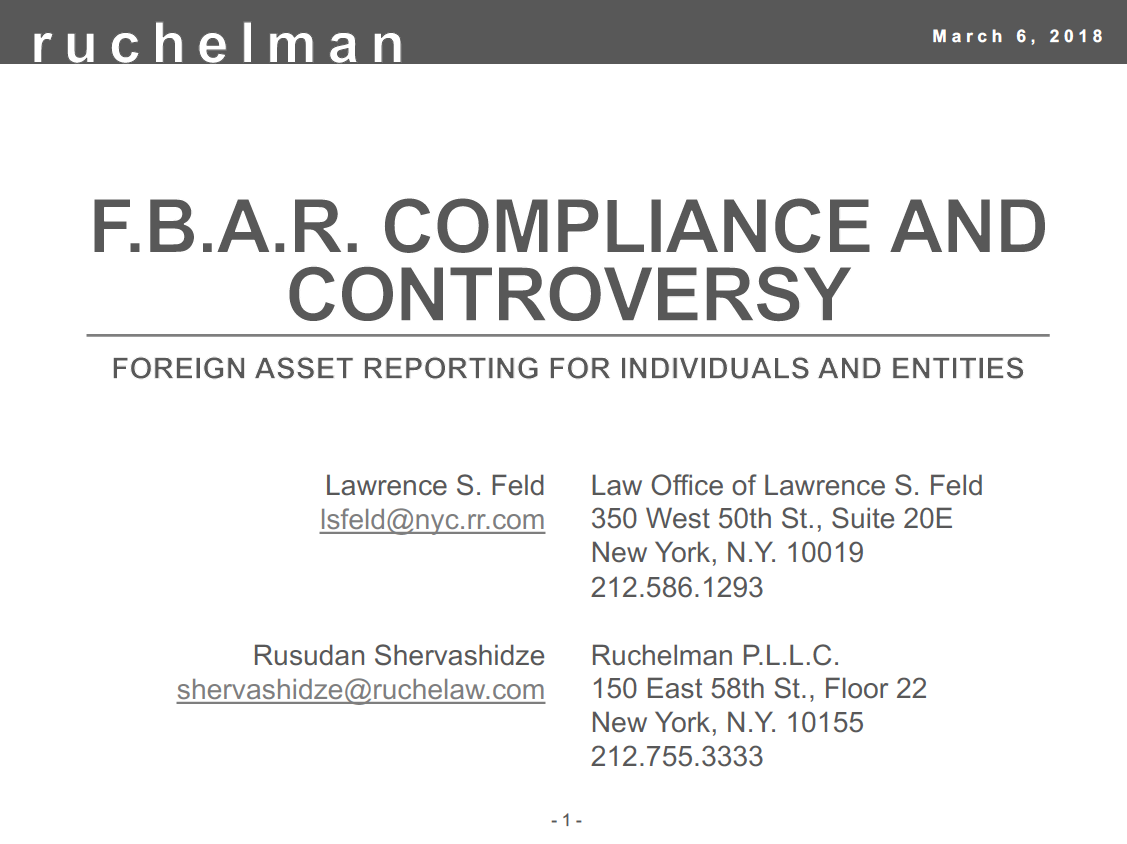
April 15 is almost here, and while most people know this date as the filing deadline for individual tax returns, it is important to another filing requirement: the Report of Foreign Bank and Financial Accounts (“F.B.A.R.”). Although the form has been around since the 1970’s, many people continue to profess ignorance of its existence. Others are simply confused about the requirements. A recent Federal case illustrates the perils of failing to file a required F.B.A.R. Rusudan Shervashidze and Nina Krauthamer explain that penalties are high, and courts are skeptical about claims of ignorance of the law, especially when taxpayers have accumulated several million dollars placed in an offshore account.

Code §59A imposes tax on U.S. corporations with substantial gross receipts when base erosion payments to related entities significantly reduce regular corporate income tax. The new tax is known as the base erosion and anti-abuse tax (“B.E.A.T.”). In the second of a two-part series, Rusudan Shervashidze and Stanley C. Ruchelman address (i) the coordination of two sets of limitations on deductions when payments are subject to B.E.A.T. and the Code §163(j) limitation on business interest expense deductions, (ii) the computation of modified taxable income in years when an N.O.L. carryover can reduce taxable income, (iii) application of B.E.A.T. to partnerships and their partners, and (iv) the application of the B.E.A.T. to banks and insurance companies.

Code §59A imposes tax on U.S. corporations with substantial gross receipts when base erosion payments to related entities significantly reduce regular corporate income tax. The new tax is known as the base erosion and anti-abuse tax (“B.E.A.T.”). In late December 2019, the I.R.S. proposed regulations that provide guidance for affected taxpayers. The proposed regulations provide a playbook for making required computations including (i) the gross receipts test to determine if the taxpayer meets the $500 million gross receipts requirement, (ii) the base erosion percentage test, (iii) how to apply the tests when a taxpayer is member of an Aggregate Group having members with differing year-ends, (iv) various computations to determine whether a non-cash transaction is considered to be a payment to a related party outside the U.S. or is outside the scope of the B.E.A.T., and (v) other exceptions from the B.E.A.T. In the first of a multi-part series, Rusudan Shervashidze and Stanley C. Ruchelman tell all.

Over time, the attorney-client privilege, which protects information disclosed by a client, has been extended to include certain client communications to accountants retained by legal counsel to provide input regarding the application of accounting rules. However, the privilege does not apply when a client retains the accountant prepare tax returns. In U.S. v. Adams, the I.R.S. challenged the extension of the privilege to an accountant who provided advice to the client’s defense counsel and later prepared U.S. tax returns for the client. The decision likely satisfies neither the I.R.S. nor the taxpayer. Rusudan Shervashidze and Stanley C. Ruchelman explain the I.R.S. challenge and the Solomon-like solution reached by the court.

This month, Rusudan Shervashidze and Stanley C. Ruchelman look at several interesting items, including (i) the publication of draft legislation by the Crown Dependencies of Guernsey, Jersey, and Isle of Man calling for the existence of economic substance for resident companies engaged in certain businesses and defining what that means, (ii) the denial of benefits incident to foreign earned income for a military contractor in Afghanistan who maintained a place of abode in the U.S., (iii) an increase in fees charged by the I.R.S. to issue residency certificates, (iv) the establishment of a working group to combat transnational tax crime through increased enforcement collaboration among tax authorities in several countries, and (v) changes to China’s residency rules and the sharing of taxpayer financial information under C.R.S.

The I.R.S. has published proposed regulations on the global intangible low-taxed income ("G.I.L.T.I.") regime, which is applicable to those controlled foreign corporations that manage to operate globally without generating effectively connected income taxable to the foreign corporation or Subpart F Income taxable to its U.S. Shareholders. In a detailed article, Rusudan Shervashidze, Elizabeth V. Zanet, and Stanley C. Ruchelman examine the proposed regulations and all their complexity.

The I.R.S. has published proposed regulations on Code §965, which requires a U.S. Shareholder to pay income tax on a pro rata share of previously untaxed foreign earnings held in a C.F.C. and certain other foreign corporations. The tax is commonly referred to as the transition tax. It is designed to tax deferred foreign income prior to the transition to a participation exemption system for intercompany dividends from certain foreign corporations. A multi-step computation is required to (i) measure post-1986 E&P, (ii) allocate E&P deficits among affiliated foreign corporations, (iii) calculate the aggregate foreign cash position, (iv) compute allowed deductions, and (v) determine foreign tax credits. Elizabeth V. Zanet, Rusudan Shervashidze, and Beate Erwin detail the required steps as well as special rules applicable to individuals.

When F.A.T.C.A. was adopted in 2010, the hoopla from the U.S. Senate promoted the idea that the I.R.S. would become invincible in rooting out recalcitrant Americans not wanting to pay tax and the financial institutions willing to assist them. In principle, information in U.S. tax returns could be compared with F.A.T.C.A. reporting by foreign financial institutions to identify which taxpayers remained offside and which banks had insufficient reporting systems. A recent report by the Treasury Inspector General for Tax Administration (“T.I.G.T.A.”) concluded that after spending nearly $380 million, the I.R.S. is still not prepared to enforce F.A.T.C.A. compliance. In their article, Rusudan Shervashidze and Nina Krauthamer summarize the principal shortfalls and possible solutions identified by T.I.G.T.A. and which suggested action plans the I.R.S. will contemplate.

This month, Rusudan Shervashidze, Neha Rastogi, and Nina Krauthamer look at several interesting updates and tidbits, including (i) potential tax reasons for Cristiano Ronaldo’s move to Italy, (ii) a law suit brought by high-tax states against the U.S. Federal government in connection with the T.C.J.A. limitations on deductions for state and local taxes, (iii) the finding of the European Commission that the aid given to McDonalds by the Luxembourg government did not constitute illegal State Aid, and (iv) a successful F.A.T.C.A. prosecution against a former executive of Loyal Bank Ltd.

In today’s global environment, it is not surprising to find that a beneficiary of a foreign estate or trust is living in the U.S. An interest in a foreign trust can be problematic for the beneficiary if the foreign trust invests through a foreign “blocker” corporation that holds passive assets (such as publicly traded stocks and securities) or a foreign mutual fund. These companies can stumble into P.F.I.C. categorization for U.S. tax purposes, which yields sub-optimal tax consequences for the U.S. beneficiary. Rusudan Shervashidze and Nina Krauthamer break down the U.S. tax rules that make a foreign corporation a P.F.I.C., the various ways in which a U.S. investor in a P.F.I.C. will be taxed, and the reporting obligations that are imposed on the U.S. investor in a P.F.I.C.

This month, Rusudan Shervashidze and Nina Krauthamer look at several interesting updates and tidbits, including (i) limited relief for transition tax, (ii) a new twist to phishing that involves fake I.R.S. calls, (iii) another twist on phony correspondence requesting W-8BEN information that is used to obtain persona information often used by banks to confirm identities of customers, and (iv) new FinCEN money transmitter rules that apply to I.C.O.’s.

In a post-B.E.P.S. world, aggressive tax planning is a mortal sin. If a principal purpose or a main purpose of entering a transaction is tax avoidance, the tax benefits are lost. A ruling in a recent pre-trial hearing in the U.S. Tax Court addressed a clearly abusive transaction aimed at importing high-basis, low-value assets into a U.S. partnership so that the U.S. investors could benefit from losses on nonperforming loans. The I.R.S. moved for summary judgment in its favor, but the motion was denied. Under applicable case law, a transaction can be respected even if it is tax motivated as long as economic substance is present. Consequently, the taxpayer is entitled to a day in court, even if the prospect of victory is slim. Rusudan Shervashidze and Stanley C. Ruchelman compare the approach followed by the U.S. Tax Court with the principal purpose test rules of the A.T.A.D. and B.E.P.S.

On the way toward a dividends received deduction for certain dividends paid by foreign subsidiaries, Congress enacted a one-shot income inclusion of all post-1986 earnings from C.F.C.’s and foreign corporations having 10% U.S. Shareholders that are corporations. In March, the I.R.S. issued an F.A.Q. providing additional guidance on open issues for 2017 tax returns. Rusudan Shervashidze and Stanley C. Ruchelman explain the mechanics of the income inclusion and an election to defer payments for eight years, sometimes more.

U.S. tax law allows a domestic corporation to elect pass-thru tax treatment of income by making an S-corporation election. Several conditions must be satisfied before the election can be made, including a prohibition of any foreign ownership. In an almost invisible provision of the T.C.J.A., U.S. tax law has been revised to allow an individual who is neither a citizen nor a U.S. resident to hold an indirect current interest in an S-corporation without causing an automatic termination of pass-thru treatment for the corporation. The key is for the current interest to be held through an Electing Small Business Trust that qualifies as a domestic trust for U.S. tax purposes. This may be a boon for Canadian-resident individuals who face mind and management issues when a U.S. L.L.C. is established to invest in a U.S. opportunity. Rusudan Shervashidze and Stanley C. Ruchelman explain all.

International tax planning in the U.S. has been turned on its head by the Tax Cuts and Jobs Act (“T.C.J.A.”). This article looks at (i) the new dividends received deduction that eliminates U.S. tax on the receipt of direct investment dividends paid by a 10%-owned foreign corporation to a U.S. corporation, (ii) the repatriation of post-1986 net accumulated earnings of 10%-owned foreign corporations by U.S. persons and the accompanying deferred tax rules, (iii) changes to Code §367(a) that eliminate an exemption from tax on outbound transfers of assets that will be used in the active conduct of a foreign trade or business, and (iv) a broadening of the scope of Subpart F income by reason of a change to certain definitions. Rusudan Shervashidze and Stanley C. Ruchelman address and comment on these revisions.

Foreign persons owning artwork physically located in the U.S. must be mindful of special income, estate, and gift taxes associated with that ownership. In the second of a series, Rusudan Shervashidze and Nina Krauthamer look at issues such as use tax, which is the U.S. equivalent of a reverse charge of V.A.T., estate tax, and gift tax.

Taxpayers holding valuable works of art receive different tax treatment, depending on the characterization of the individual. Is the individual the artist, a dealer, an investor, or a collector? Rusudan Shervashidze and Nina Krauthamer examine various planning tools available, focusing mostly on the collector.

Tax-smart investors in U.S. real estate understand that the principal method of disposing real property is to participate in a two-party swap transaction with the ultimate purchaser or a three-party deferred swap through a qualified intermediary. In Bartell v. Commr., the U.S. Tax Court allowed a replacement property to be purchased by an exchange accommodation title holder with whom it was parked for 17 months prior to its transfer. However, the I.R.S. has issued a notice of nonacquiescence, advising taxpayers that it disagrees with the holding of the court. Rusudan Shervashidze and Nina Krauthamer explain the facts in Bartell, the safe harbor that was published in Rev. Proc 2000-37, and the status of the facilitator as a beneficial owner for purposes of allowing tax deferral in the swap transaction.

The U.S. enters into bilateral investment treaties to protect and promote foreign investment. Unlike double taxation agreements, which relate exclusively to tax matters, they are not usually seen as a defense mechanism when dealing with foreign tax authorities. Interestingly, they are! Rusudan Shervashidze and Nina Krauthamer explain.

“Phishing.” Many have heard the word, which is used to describe scams intended to acquire sensitive information. Few are prepared to be its target. Unwary individuals are often drawn in by scammers pretending to call from the I.R.S. and threatening imprisonment unless a bogus tax bill is paid promptly. Rusudan Shervashidze offers insights into the workings of these scammers, relaying her personal experience with an “I.R.S.” phishing call and providing tips to avoid falling into one of these traps.

When transactional tax advisers come across estate planning advice, amazement is often expressed over the importance given to form rather than economic substance. Value can be reduced when property is transferred to a family partnership. In Estate of Powell, the Tax Court went beyond form to look at substance in determining the scope of the decedent’s taxable estate. Galia Antebi and Rusudan Shervashidze explore the holding of the case.

In Rev. Rul. 2017-09, the I.R.S. addressed “north-south” transactions. In these transactions, a shareholder transfers property to a corporation in a transaction structured to be free of tax under Code §351. At about the same time, the corporation distributes shares of its subsidiary to the shareholder in a spinoff. If the transactions are considered separate for income tax purposes, each can be effected free of gain recognition and the imposition of income tax. On the other hand, if the transactions are integrated into a single multi-step transaction, gain will be recognized and tax imposed on each step of the arrangement. The ruling announces that the I.R.S. will once again rule on the status of these transactions and provides guidance on the standard that the I.R.S. will apply. Rusudan Shervashidze and Nina Krauthamer explain the factual context and the approach of the I.R.S. in granting relief.

In April, coordinated tax raids targeted three separate offices Credit Suisse involved in tax fraud examinations by the Netherlands, France, Germany, the U.K., and Australia. Was it merely a coincidence that these are countries with which the U.S. regularly cooperates in the exchange of tax information? Rusudan Shervashidze and Stanley C. Ruchelman discuss the many avenues through which the I.R.S. furnishes and receives information. One thing is clear: The I.R.S. had the means to transfer information to the relevant tax authorities.

Section 911 of U.S. tax law provides certain tax benefits to persons who report foreign earned income. To be entitled to the benefits, an individual must have a “tax home” abroad, provided that he or she does not have an “abode” in the U.S. A recent summary opinion by the Tax Court illustrates the difference between those two terms. Rusudan Shervashidze and Philip R. Hirschfeld explain.

Tax planners to New York City real estate families understand that real estate should never be sold. Rather, it should be exchanged in a tax-free, like-kind exchange. The exchange can be bifurcated into two independent transactions – one a purchase and the other a sale – without affecting tax-free treatment, provided certain well identified rules are followed. Moreover, the replacement can be acquired before the sale of an existing parcel is effected. In a recent advisory opinion affecting property in New York State, the Department of Taxation and Finance issued a taxpayer-friendly advisory opinion involving real estate transfer tax exposure in a reverse like-kind exchange. Rusudan Shervashidze and Nina Krauthamer explain the ruling.

Code §338(g) allows a taxpayer to elect to treat certain share purchases as if the transactions were asset purchases. As a result, the premium paid for the shares can be pushed down to increase the basis in operating assets of the acquired company. The step-up in depreciable basis results in steeper depreciation and amortization deductions for U.S. tax purposes. Because a comparable tax benefit is not obtained in the jurisdiction where the target operates, the Code §338(g) treatment magnifies the effective tax rate in the foreign country when looked at from a U.S. tax viewpoint. This creates mountains of excess foreign tax credits that can be used to reduce U.S. tax on other items of foreign-source income, provided those items are subject to little or no foreign tax and fall within the same foreign tax credit limitation basket. A similar result can be achieved through a check-the-box election, which acts as a poor man’s Code §338(g) election. Code §901(m) attempts to disallow the enhanced level of the foreign tax credit, and the I.R.S. recently issued temporary and proposed regulations. Rusudan Shervashidze and Stanley C. Ruchelman explain the labyrinth of rules.
RUCHELMAN
Ruchelman P.L.L.C. provides a wide range of tax planning and legal services for foreign companies operating in the U.S., foreign financial institutions operating ...
Ruchelman P.L.L.C. | 150 East 58th Street, 22nd Floor | New York, N.Y. 10155 | T. 212.755.3333 | F. 212.755.5898
Disclaimer | Privacy Policy | Attorney Advertising
© 2026 Ruchelman P.L.L.C. All rights reserved.
Disclaimer | Privacy Policy | Attorney Advertising
© 2026 Ruchelman P.L.L.C. All rights reserved.