Ruchelman Hosts First Seminar of the Year
/ Ruchelman P.L.L.C.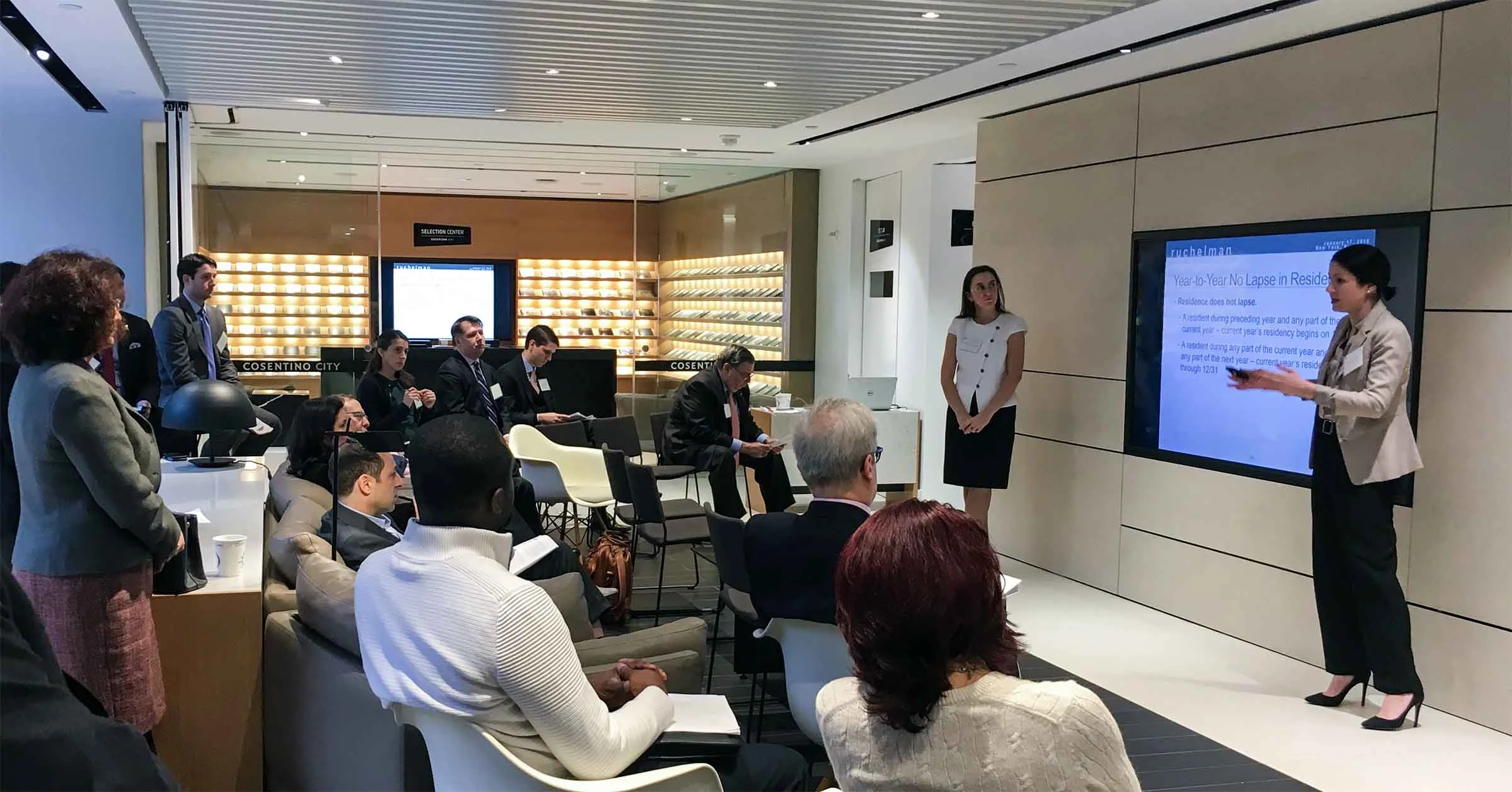
Ruchelman P.L.L.C. was pleased to present its first seminar of the year at the Cosentino City showroom. This special program featured insights from Alev Fanny Karaman and Rusudan Shervashidze on the tax rules that affect individuals moving across borders.
Download the slides: Pre-Immigration Income Planning at Cosentino City

The term “intentionally defective” sounds problematic, but in reality, is quite favorable when it comes to estate planning. Intentionally defective grantor trusts are an especially useful tool when combined with pre-immigration planning for a family where only one spouse is a U.S. citizen because these trusts are disregarded for income tax purposes but respected for estate tax purposes. If set up and funded by a non-citizen spouse before arrival in the U.S., gift and estate tax planning can be achieved in a low tax environment. In these trusts, the settlor continues to pay tax on the income even though not a beneficiary. As a result, the beneficiary does not pay income tax on trust distributions and the tax payment by the grantor is not considered to be gift to the beneficiary. Hence, no gift tax. Fanny Karaman and Nina Krauthamer explain all.

Late last year, the Italian government enacted a new regime designed to entice wealthy individuals into becoming tax residents. In late May, operating rules for the new tax regime were announced. In broad terms, the regime imposes an annual tax charge of €100,000 in lieu of tax imposed at standard rates and an exclusion from inheritance and gift tax on foreign assets. Andrea Tavecchio and Riccardo Barone of Tavecchio Caldara & Associati in Milan, Italy explain the details of the new regime.

Ever heard of qualified small business stock (“Q.S.B.S.”) as a means of investing in start-up companies? Although it is not typically thought of as a tax planning tool for foreign investors, when the foreign person is an applicant for an EB-5 visa, the tax results can be surprisingly good. Fanny Karaman and Beate Erwin explain.

Concepts of usufruct and bare legal ownership are widely used estate planning tools by parents resident in civil law jurisdictions in Europe. However, when the next generation is resident in a common law jurisdiction such as the U.S., the results are not always pretty. Fanny Karaman and Beate Erwin examine the tax consequences for the U.S. children and the steps available to the European parents that may limit adverse tax consequences in the U.S.

Wealthy persons moving to the U.S. often engage a tax adviser to craft a pre-immigration plan. Typically, the plans focus on harvesting gains, stepping up the basis in appreciated assets that cannot be sold, and simplifying structures to ensure that future gains will benefit from favorable long-term capital gains rates. However, the truly sophisticated client may wish to take a long-range approach that maximizes the accumulation of wealth during life. John F. McLaughlin and Shelly Meerovitch of Bernstein’s Wealth Planning and Analysis Group, New York, explain the benefits of forming a pre-immigration drop-off trust to invest in a private placement life insurance (“P.P.L.I.”) policy. In optimal circumstances, the P.P.L.I. investment portfolio can maximize the accumulation of wealth, provided the client obtains timely and competent legal advice in the country of residence and the U.S.

As non-domiciled (“Non-Dom”) residents of the U.K. scramble to restructure in light of the new rules for persons holding Non-Dom status for more than 15 years, Italy has adopted new measures to attract high net worth individuals. The rules are clearly derived from the Non-Dom rules in the U.K., but the weather is better. Fabio Chiarenza of Gianni, Origoni, Grippo, Cappelli & Partners explains the new provisions.
Heard of the “Beckham Law” that limits income tax in Spain for certain non-domiciled individuals? Think of European football (soccer) players. Pablo Alarcón Espinosa of Alarcón-Espinosa, Abogados in Madrid explains how persons migrating to Spain for work purposes can avail themselves of a reduced tax regime for domestic income and an exemption for foreign income and gains. Like Switzerland, remittances from abroad are not penalized with tax.
With the 15-year limit enacted to remittance based tax rules for non-domiciled individuals resident in the U.K., we offer a series of articles this month addressing favorable tax rules for non-domiciled resident individuals in several countries. Gary Ashford of Harbottle and Lewis L.L.P. in London is the lead-off author, explaining the U.K. tax and immigration rules and suggesting strategies for the long-term non-domiciled resident who faces the 15-year ceiling. The ceiling becomes effective in 2017.